


4 Myths About Orthopedic Care
Joint pain and injuries are common, but so are misconceptions about when to seek care and what an orthopedic appointment involves.
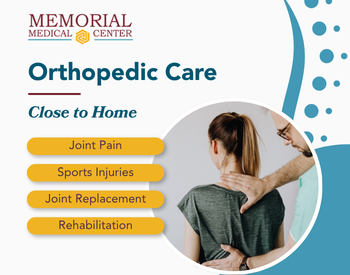
At Memorial Medical Center, orthopedic care ranges from nonsurgical treatment and sports medicine to surgery, joint replacement, imaging, and rehabilitation. Here are four common myths worth clearing up.
Myth 1: Seeing an orthopedic surgeon means I'll need surgery.
Fact: Surgery is only one of many treatment options.
Depending on the cause and severity of a problem, orthopedic treatment may include cortisone or gel injections, bracing, casting, splinting, physical therapy, activity modification, or other conservative approaches.
"Our goal is to find the treatment that makes the most sense for the individual patient," said Jerry L. Followwill, M.D., board-certified orthopedic surgeon at Memorial Medical Center. "For many people, that does not mean surgery."
Myth 2: I should wait until the pain becomes severe.
Fact: You do not have to wait until pain becomes unbearable to have it evaluated.
Persistent pain, recurring injuries, limited movement, difficulty sleeping, or changes in everyday activities may all be reasons to talk with an orthopedic specialist.
Getting evaluated earlier can help identify what is causing the problem and what options may be available.
Myth 3: Sports medicine is only for athletes.
Fact: Sports medicine treats injuries related to movement and activity, whether they happen on a field, at work, at home, or during routine exercise.
Drs. Moody and Followwill have specialized training in sports medicine and treat conditions including sprains and strains, tendon and ligament injuries, overuse injuries, meniscus and labral tears, and joint instability.
You do not need to be a competitive athlete to benefit from sports medicine expertise.
Myth 4: Advanced orthopedic care means traveling out of town.
Fact: A wide range of orthopedic services are available right here in Port Lavaca.
Memorial Medical Center provides access to orthopedic evaluation, diagnostic imaging, nonsurgical treatment, inpatient and outpatient surgery, and rehabilitation.
Surgical services include procedures such as knee and shoulder arthroscopy, ACL reconstruction, rotator cuff repair, meniscus repair, Achilles tendon repair, and hip, knee, and shoulder replacement.
For patients who need rehabilitation afterward, physical therapy is also available locally to support recovery.
Know Your Options
Joint pain or an injury does not automatically mean surgery, and it does not necessarily mean leaving the community for care. The first step is simply finding out what is causing the problem.
To learn more about orthopedic services or schedule an appointment, call 361-552-0379.